The Five Pillars of Agentic AI
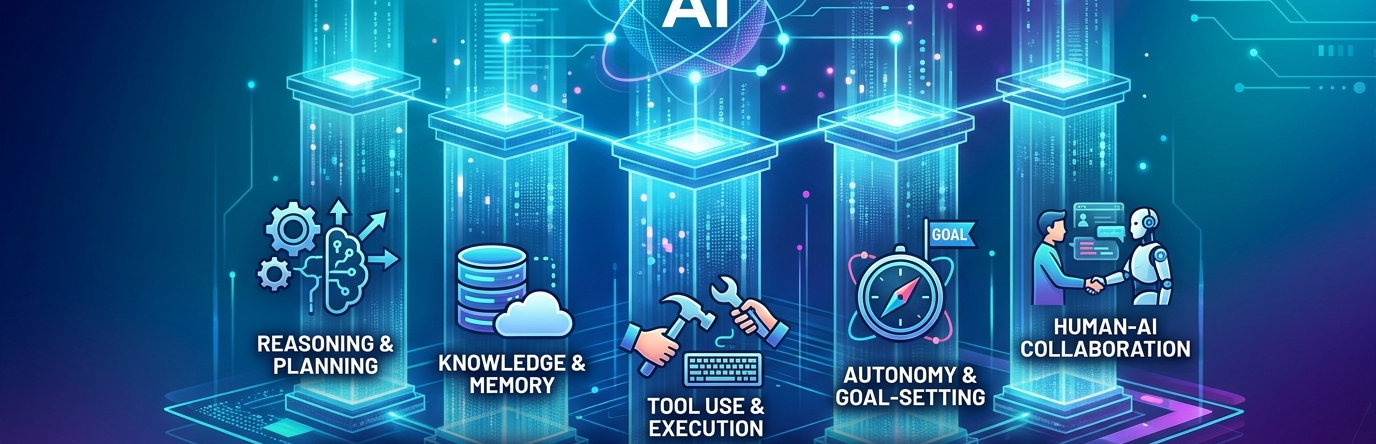
The shift from traditional language models to agentic AI systems represents one of the most significant architectural transitions in modern AI engineering. Where a conventional LLM responds to a prompt and terminates, an agent perceives its environment, reasons about it, plans multi-step solutions, executes actions using external tools, and retains context across an extended operational timeline.
Understanding what makes an agent an agent — at a technical level — requires decomposing the system into five foundational components. These are not abstract concepts; they map directly to architectural decisions, framework choices, and engineering trade-offs you will encounter when building or evaluating agentic systems.
Pillar 1: Memory
How agents persist and retrieve state
Memory in agentic systems exists across multiple tiers, each with distinct latency, capacity, and persistence characteristics. Without an explicit memory architecture, an agent is effectively stateless: incapable of learning from prior steps or referencing earlier outputs within a session.
- In-context (working) memory: The model’s active context window. Fast, temporary, and bounded by token limits (typically 8K–200K tokens depending on the model). Ideal for within-session task tracking.
- External / vector memory: Embeddings stored in vector databases (Pinecone, Weaviate, pgvector). Retrieved via semantic similarity search. Enables long-term recall across sessions and scales independently of context length.
- Episodic memory: Structured logs of previous actions, observations, and outcomes. Can be replayed or summarized to inform future decisions. Analogous to an agent’s “experience replay” buffer in reinforcement learning.
Engineering consideration: The retrieval strategy is critical. Naive top-k similarity search introduces hallucinated or irrelevant context. Hybrid retrieval (dense + sparse) and re-ranking pipelines significantly improve memory fidelity in production systems.
Pillar 2: Planning
How agents decompose goals and sequence actions
Planning is the cognitive core of an agent. Given a high-level objective, the agent must decompose it into an ordered sequence of sub-tasks, reason about dependencies, handle uncertainty, and dynamically replan when execution diverges from expectation.
Key planning paradigms include:
- ReAct (Reason + Act): Interleaves chain-of-thought reasoning with tool invocations. The model emits a thought, selects an action, observes the result, and continues. Effective for exploratory tasks but susceptible to compounding reasoning errors.
- Plan-and-Execute: Separates the planning phase from execution. A planner LLM generates a full task graph upfront; an executor agent carries out each node. Better for structured, predictable workflows.
- Tree-of-Thought / MCTS-inspired planning: Explores multiple reasoning paths in parallel, scores branches, and selects optimal trajectories. Computationally expensive but yields higher-quality decisions for complex, multi-constraint problems.
Engineering consideration: Planners hallucinate dependencies and overestimate tool capabilities. Injecting explicit tool schemas, capability constraints, and failure modes into the planner’s system prompt significantly reduces plan infeasibility.
Pillar 3: Tools
How agents act beyond their training distribution
A model without tool access is a closed system. Tools are the interface layer between the agent’s reasoning and the external world. They are the mechanism by which an agent’s decisions produce real-world effects. Tool use is typically implemented via function calling (structured JSON schemas declared to the model) or through MCP (Model Context Protocol) servers that expose standardized interfaces.
Tool categories in production agent systems:
- Information retrieval: Web search, vector DB queries, document parsers. Grounds the agent in current, factual data beyond the training cutoff.
- Code execution: Sandboxed Python/JS interpreters. Enables computation, data analysis, file generation, and testable outputs rather than hallucinated results.
- External APIs: REST/GraphQL endpoints for CRUD operations on third-party systems (CRMs, calendars, databases). Converts agent intent into durable system state.
- Agentic spawning: The ability to instantiate sub-agents or delegate to specialized agents. Critical for parallelism and task decomposition in multi-agent architectures.
Engineering consideration: Tool call reliability degrades sharply beyond 10–12 tools in a single context. Use tool routing (a classifier that selects a relevant tool subset per task) to keep the effective tool space manageable.
Pillar 4: Perception
How agents sense and interpret their environment
Perception defines the input modalities an agent can process and interpret. An agent’s ability to act is fundamentally bounded by what it can perceive. Early agents were text-only; modern frontier models support multimodal perception across text, images, documents, structured data, and increasingly, live system signals.
- Text and structured data: Natural language, JSON, HTML, Markdown. The baseline modality for all current agents.
- Visual input: Screenshots, UI state, diagrams, charts. Critical for computer-use agents that interact with GUIs rather than APIs.
- Documents and PDFs: Parsed via specialized extractors or natively by multimodal models. Enables document-driven workflows like contract analysis and compliance review.
- Real-time event streams: Webhook payloads, monitoring alerts, log streams. Allows agents to operate reactively in event-driven architectures rather than only on explicit user invocation.
Engineering consideration: Perception quality directly constrains downstream planning accuracy. Preprocessing pipelines (OCR, layout parsing, chunking strategies) are often more impactful than model selection for document-heavy agent applications.
Pillar 5: Action
How agents translate decisions into effects
Action is where cognitive processing becomes consequential. It is the output layer of the agent: the set of operations the system can perform in its environment. Action types vary dramatically in reversibility, latency, and risk profile, which has direct implications for safety architecture and human-in-the-loop design.
- Read-only / informational actions: Querying, summarizing, generating content. Low risk, fully reversible (the action produces no side effects on external systems).
- Write / mutation actions: Creating records, sending messages, modifying files. Reversibility depends on the system; most require explicit rollback logic.
- Orchestration actions: Spawning sub-agents, invoking workflows, calling webhooks. High blast radius if misconfigured. Requires strict permission scoping and audit logging.
- Physical-world actions (emerging): Controlling robotic systems, IoT devices, or autonomous vehicles. Introduces safety constraints that go well beyond software-layer guardrails.
Engineering consideration: Implement a risk-tiered action model. Classify every tool by its action type and reversibility. Apply automatic human confirmation gates to high-risk, low-reversibility actions. Use dry-run modes during development to observe planned actions before execution.
How the Five Pillars Compose at Runtime
These pillars are not independent modules; they form a tightly coupled execution loop. A runtime cycle for a typical agentic task proceeds as follows:
- Perception ingests the current environment state (user input, tool results, event signals).
- Memory retrieves relevant context from past episodes and injects it into the active context window.
- Planning reasons over the enriched context and emits the next action or sub-task sequence.
- Tools are invoked to carry out the planned action, producing observations or side effects.
- Action commits the final output to the target system, completes a user-facing response, or loops back if the goal is not yet achieved.
This loop runs iteratively until a termination condition is met: task completion, a maximum step budget, an error threshold, or an explicit human interrupt. The sophistication of each pillar and the quality of the interfaces between them determine the overall capability and reliability ceiling of the agent.
Conclusion
Agentic AI is not a single technology; it is an architectural pattern. The five pillars — memory, planning, tools, perception, and action — each represent a distinct engineering surface with its own design choices, failure modes, and optimization levers. A weakness in any one pillar degrades the entire system.
For developers building in this space, the practical takeaway is to evaluate agent systems pillar-by-pillar: How does the agent remember? How does it plan when things go wrong? What is its tool call accuracy under realistic load? What input modalities does it actually support in production? And critically, what safeguards govern its highest-risk actions?
As frontier models improve and agent frameworks mature, the bottleneck will increasingly shift from raw model capability to the quality of the surrounding architecture. The engineers who understand that architecture at a pillar level will be the ones who build agents that are not just impressive in demos, but reliable in production.